Report
Embedded Finance Report 2026
Finlane's 30-page buyer report on European embedded finance: the provider landscape, regulation through 2028 and a practical framework for choosing infrastructure partners.
Free with a Finlane account · PDF
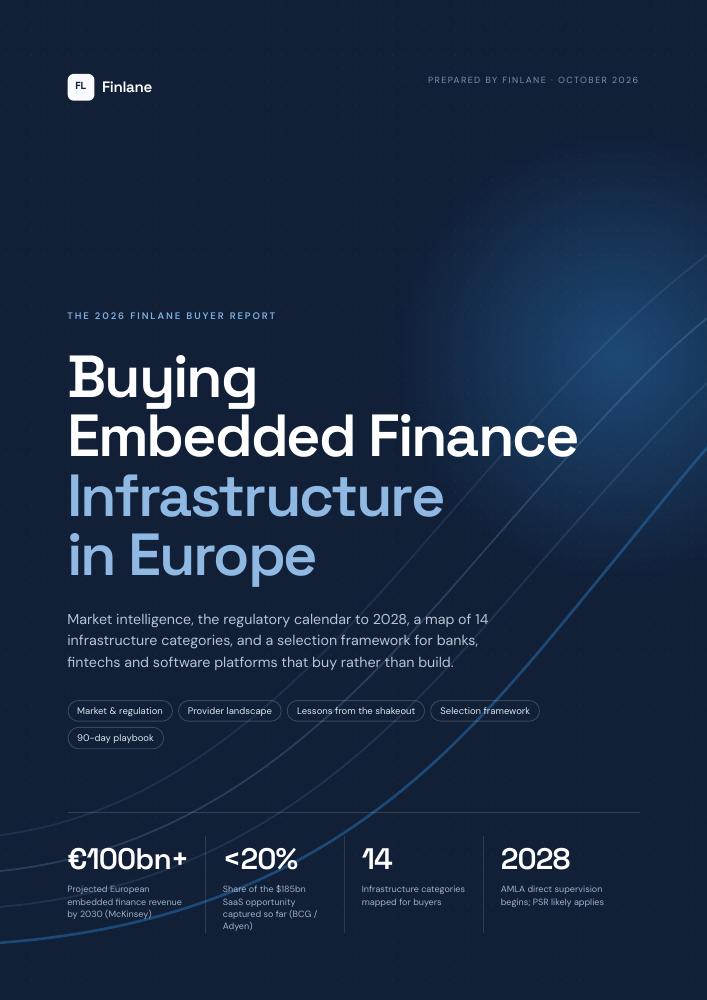
Buying embedded finance infrastructure in Europe
Choosing an infrastructure partner is no longer just a question of comparing APIs. Banks, fintechs and software platforms need to understand who carries the regulatory risk, how resilient a provider is, and what happens if that partner changes ownership or the relationship ends.
The 2026 Finlane Buyer Report brings together market intelligence, a regulatory calendar through 2028, a map of 14 infrastructure categories, and a selection framework for businesses that buy rather than build. It is written for the people who have to sign the contract and live with the decision.
A preview from the foreword
What has changed is where the difficulty sits. Five years ago, the hard part was finding anyone who could provide the infrastructure. Today, the hard part is choosing well among dozens of providers that look alike in a demo and behave very differently under stress, in a regulatory audit, or when you try to leave.
We built Finlane because that selection work is still done badly. Buyers hold five differently-shaped sales conversations and try to compare them afterwards. Providers answer the same security and licensing questions hundreds of times. Consultants rebuild the same requirements templates from scratch for every client. Nobody benefits from that friction.
— Maximilian Jarczyk, Founder, Finlane
Inside the report
- The European market in 2026: where the opportunity sits and how the market has moved from hype to harder commercial realities.
- The regulatory calendar, 2025–2028: instant payments, safeguarding, consumer credit, PSD3/PSR, AML rules and MiCA, with their implications for procurement.
- The infrastructure stack: five layers, three licence models and the question of who actually owns each risk.
- The provider landscape: 14 infrastructure categories, a buyer's risk map and build, buy or partner decisions.
- Lessons from the shakeout: provider failures, supervisory actions and consolidation, translated into controls buyers should demand.
- New payment rails: instant payments, Wero and Euro stablecoins, and questions to ask about readiness.
- A practical selection framework: a weighted scorecard, total cost of ownership and diligence questions.
- A 90-day procurement playbook: five phases from a clear brief to a signed contract, including common mistakes to avoid.
Who it is for
The report is intended for banks, fintechs, vertical SaaS businesses, marketplaces, lenders, payment service providers and spend-management platforms evaluating infrastructure partners. Consultants and providers can also use its framework to make requirements and responses more comparable.
The full PDF includes an executive summary, buyer-specific starting points, a glossary and consolidated sources. Market and regulatory information is current as of 18 October 2026. Third-party market estimates are attributed in the report; it is for information only, not legal, regulatory or investment advice.
Related reading
- Seven reasons BaaS providers reject applicantsRejection from a banking-as-a-service provider is usually a risk decision made early and rarely explained. Here are the seven reasons it happens — and what to change before you apply again.
- Paying marketplace sellers across bordersSeller payouts across corridors: what breaks, which provider categories are involved, and the questions that separate a payout provider that works from one that looks like it does.
- Launching a business account inside a SaaS platformWhat a vertical SaaS platform needs to offer its customers a branded business account: the licence question, the stack, the onboarding reality and the sequence to procure in.